I build AI workflows inside the software your firm already pays for. Your case system, your inbox, your calendar. Intake, chasing documents and first-draft paperwork stop being somebody’s job.
Book your free discovery →Each one takes a job somebody at your firm currently does by hand. Pick whichever sounds closest to your week.
A prospect emails Friday at 5pm. By Monday they have hired someone else. This system replies within minutes, keeps following up, and books the consultation without you touching it.
Booking, intake forms, document collection and conflict screening, all handled between first contact and a signed retainer. No email chain before the file even opens.
Engagement letters, NDAs and standard forms drafted from a single intake response. No copy-paste from last year’s file, no retainer amount typed in wrong. First draft in seconds.
Four agents built for personal injury and family matters: a Damages Calculator, a Medical Chronology Builder, a Discovery Digestor and a Demand Package Generator. Feed in the case file and get structured output in minutes.
A live view of every active matter: deadlines, outstanding documents, last client contact, next action. Built in Google Sheets or Notion, so there is no case management licence to buy.
Someone asks ChatGPT or Google’s AI Overview for a lawyer in your area. Three or four firms get named. Most boutiques are not among them, and the SEO retainer they paid in 2021 does not put them there either. AEO (answer engine optimisation) and GEO (generative engine optimisation) are about getting quoted by the model instead of listed underneath it.
Three questions, no email needed. It updates as you click, including the parts where your software makes life difficult.
ChatGPT gives you generic answers because it has never read your precedents. Here is how a firm builds one that has, without the files leaving its control.
Closed matters, precedents, retainer and engagement templates, old demand packages, internal memos, the email where a partner explained how something is done. Most firms have a decade of this sitting in a folder nobody opens.
Client identifiers come out before anything is indexed. What the model picks up is how your firm works: the way you build a chronology, the wording in your retainer, the arguments you tend to run. You sign off the redaction rules before a single file is processed.
Everything is indexed into a store only your firm can query, in your own cloud tenancy or an isolated one I set up. None of it goes to a public training set and it is never pooled with another firm’s material. If you walk away, the index and the documents go with you.
Ask how your firm words a limitation-period warning and it quotes the file it came from. The Law Society holds the lawyer accountable for the output, so an answer you cannot trace back is an answer you cannot use.
This is a retrieval layer over your own documents, plus an optional fine-tune on your drafting style. It is not a foundation model trained from scratch for your firm. Nobody builds those for a six-lawyer practice and the cost would be ridiculous. What you get is a model answering out of your material instead of the open internet, under your control, with a record of where each answer came from.
Seven stages, from a 15-minute call to something running on its own. Stages four and five are where this normally goes wrong, so they get most of the room below.
Tested end to end against the awkward files, not just the ones that behave. I build the review queue before the automation. If nobody at your firm can see what it is doing and correct it on day one, it is not finished. You come out of this stage with a runbook, a walkthrough recording and a written SOP, and you keep all three whether or not you keep working with me.
It runs on your real files and writes down every decision it would have made, without making any of them. You read the log. I count two kinds of mistake separately, because they are not equally survivable. Saving a document under a slightly wrong name is recoverable, and gets an accuracy bar you agree up front. Saving it against the wrong client is not, and has to be zero across the whole sample. The confidence thresholds come out of your data rather than a default I brought with me.
Two weeks is the usual length, but the exit condition is a sample size. If a quiet fortnight does not give me enough to judge it on, it runs longer.
Above the threshold it acts on its own. Anything below waits in a queue for a person. Every action is written to an audit log, so “who approved this and when” always has an answer.
Handover happens on a date rather than by drifting apart. My named access is revoked, credentials are rotated, the runbook is signed over. If you want me gone after that, nothing breaks.
Five numbers, all of them yours. The maths sits underneath.
Every assumption is a field you can change, so nothing is buried in the maths. It is arithmetic on numbers you supplied. Treat the total as your estimate, not my claim.
Get a Free Discovery →Videos and posts, mostly about builds that worked and a couple that did not.
Newest first.
A document lands and seven minutes go into naming it, filing it, logging it and forwarding it. This is the build where dropping the file is the only human step.
Watch on YouTube →
Records in, timeline out. That part is easy. Proving a lawyer verified it is not. What I got wrong the first time and what the rebuild needed.
Watch on YouTube →
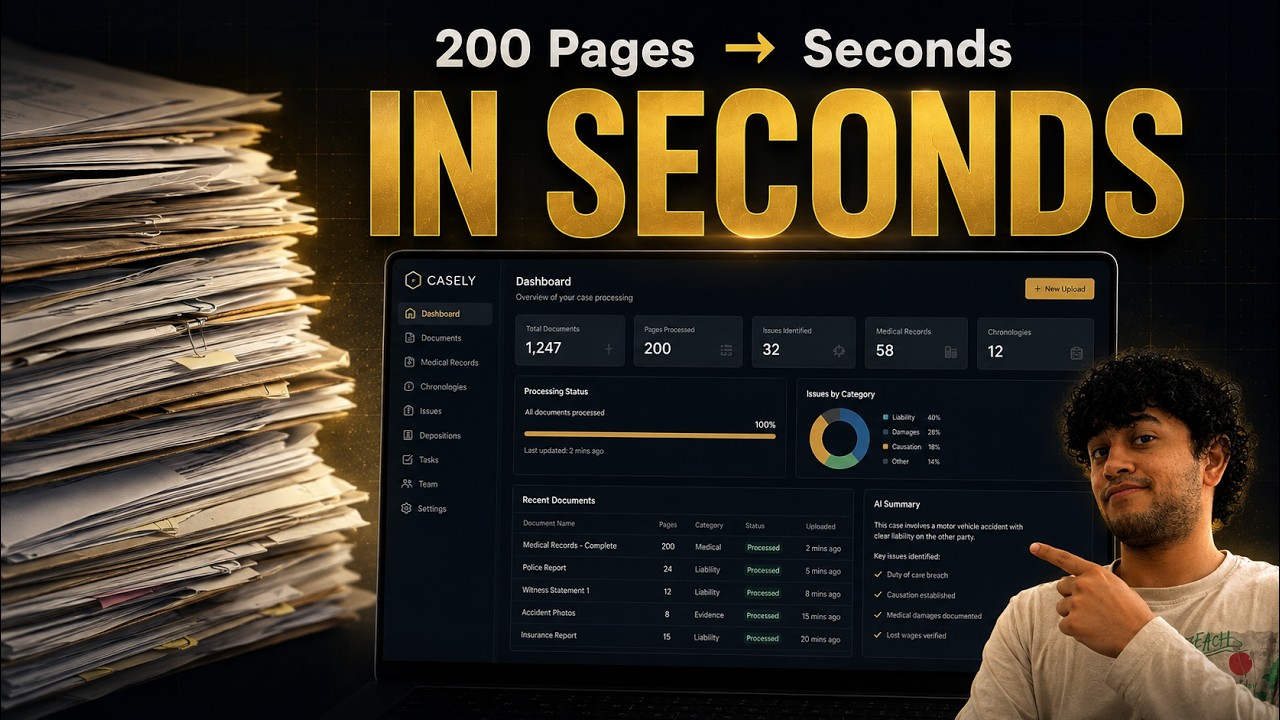
A dashboard for personal injury files that reads the full medical record and drafts off it. Live walkthrough on a sample file.
Watch on YouTube →
Why enquiries go cold between the first email and the first call, and what that gap quietly costs a boutique firm every year.
Watch on YouTube →Shorter takes, posted as I go.
Opened, identified, renamed, filed, logged, forwarded. Do the arithmetic on 35 documents a day and it is most of a full-time job spent moving files. So I built the version where the drop is the only human step.
Read the post →Law society guidance is consistent: the tool can draft, the lawyer has to verify, and someone has to be able to prove the verification happened. My first build could not. Here is what the rebuild needed.
Read the post →Every one of them had to solve the same problem before anything else worked, and it wasn’t litigation strategy — it was documents. What that taught me building a generator and a shared review dashboard.
Read the post →Guides and working builds you can take away and run yourself. All pay-what-you-want, starting at nothing.
The discovery I run with boutique firms, written up so you can work through it yourself.
Automates client intake in Claude and Clio. Opens the matter, drafts the core documents and files them, with you approving every write.
Five Claude agent prompts covering the full drafting pipeline, from intake through to the finished demand package.
All three are free if you want them to be. See everything on Gumroad →
New videos drop regularly. Subscribe on YouTube → or follow on LinkedIn →
I build the systems that sit around legal work: intake, document movement, follow-up, retrieval. I also build the outbound machinery that finds the firms who need them, which is how most of my own work turns up.
Before this, process engineering at Procter & Gamble, where I automated reporting across four converting lines. Currently finishing Mechanical Engineering at York University, in Toronto.
I am not a lawyer and I am not licensed anywhere. I build the plumbing. The legal judgement stays with your firm, and everything I ship is built so a lawyer signs off before anything leaves the file.
Shipped means it ran in the real world. Demo means I built it and ran it on sample files. I am not claiming anybody else’s results as mine.
Power BI reporting dashboard automation across 4 converting lines at P&G ($80B+ in annual sales). Manufacturing rather than legal, but it is where I learned to look at a process this way.
An automated lead pipeline that sourced, enriched and de-duplicated ten thousand Greater Toronto law-firm leads inside three days, straight into a working CRM.
The outbound system on top of that pipeline drafted, sent, tracked replies and followed up. It booked five discovery calls with Ontario law firms in three weeks.
Messages a new client on WhatsApp, chases missing documents automatically at day 3 and day 7, creates the contact, matter and Drive folder, and flags a lawyer callback at day 14. Built and demoed on a sample wrongful dismissal client.
An AI demand package generator for personal injury firms, cutting a full package from roughly four hours to four minutes in a demo on a sample motor vehicle file.
Turns a stack of medical records into an injury evidence matrix, a medical chronology, and a causation and prognosis summary, ready to drop into a demand package. Demo on a sample Ontario motor vehicle file.
A 22-page guide, 50 original legal prompts, 6 workflow blueprints and an ROI calculator. Published free, no email gate.
If a call is more than you want to commit to today, send this instead. It fills itself in from the planner above and you can rewrite every word.
You already know which hour of your week disappears. Fifteen minutes tells you whether it is fixable. You keep the answer either way, even if you never hire me.
Yash Kerpal is not a lawyer and is not licensed anywhere. I build the systems around legal work. The legal judgement stays with your firm.
No contract and no deck. Pick a time and bring a typical week.
Book your free discovery →